New York City's Best Bat Removal
We've been voted New York City's best bat removal company the past two years!
Get in touch
Bat Experts
Rapid Response
Trained & Educated
Licensed & Certified
About New York City Bat Removal
Welcome to newyorkcitybat.com. We are the only qualified bat removal company in New York City, New York. We're a licensed wildlife control company with expertise in removing bats legally and in a 100% effective manner. Whether these pests are hiding in your attic, have made their home in the walls of your home, have infested the basement and garage, or are just swarming in your property, bats are a nuisance. Apart from the fact that these animals are quite spooky, they also cause damage to your property with the bat guano and their droppings that leave ugly stains everywhere. But when it comes to getting rid of bats, the task isn't that easy and must be done by an expert only. That's because killing or poisoning any species of bats is illegal. We provide professional bat removal services for homes, offices, apartment buildings, and any type of residential or commercial property that's infested with bats. Our bat removal experts have years of experience in clearing properties infested with bats without harming the animals in any way at all. Plus, we do not trap the bats as well. If any wildlife animal is captured during the process, our team of experts ensures that the creature is safely transported to its natural habitat where it may spend the rest of its life in peace. In addition to this, after removing the entire bat colony from your property, we'd also decontaminate the space and clean all the surfaces filled with bat guano. After our experts have finished the job, you'd be left with a home that isn't just free of bats, but also clean, fresh, and without any lingering smell of bats! We operate 24-7-365, so don't hesitate to call us at 347-960-4841 to discuss your bat problem and schedule a fast appointment.
Our service areas include Manhattan, Brooklyn, The Bronx, Queens, and Staten Island.
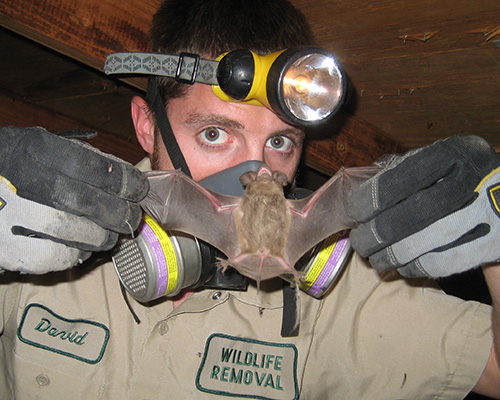
Residential
We are experts at removing bats from residential properties. Whether you have a single bat trapped in your house, a colony roosting in your attic, and/or various other problems, there is no need to worry! During our removal process, we make sure to inspect your entire home carefully, tracking down all the entrypoints bats are using to invade your place. Next, we perform a process called live exclusion (where no bats are harmed and all exit your property), then seal all entry holes completely shut. We also take care of the cleanup process after, so your home is safe and clean!
Learn MoreCommercial
Besides residential areas, we also have a wealth of experience removing bats from commercial properties! We begin by investigating the area for possible bat entrances, covering holes even as small as 1/4 of an inch. Through our live exclusion process, bats leave the building through one-way exits, and we seal up every hole afterward. Once the bats have been removed, we perform a cleanup process. This includes dealing with guano, replacing damaged insulation, and decontaminating the place.
Learn More
Contact us for bat removal today!
What Our Customers Say
I had a bat flying around in my house at 9pm, and CITY bat removal came right out and caught it in a net.
Sarah Lakewood
I had an annoying colony of bats stuck in my attic for a while before I finally decided to call for help. They were able to quickly and thoroughly solve the problem!
Brandon Chung
They did a great job clearing my attic of bats and didn't hurt any of the creatures.
Charlotte Demers
The technicians at CITY Bat Removal are skilled, professional, and know exactly what they're doing. Would highly recommend.
Mark O'Connor
My house stank of bats and their guano inside my wall. CITY Bat Removal not only removed the bats, they also got rid of the smell!
Alexis Ramirez
.jpg)
What are some of the symptoms of a sick bat?
Bats are one of the most common household intruders in the United States. With humanity expanding more and more, a bat's natural habitat has become more and more limited, thus forcing the creatures to find shelter where they can. Often, this means they sneak into your attic or your walls, looking for shelter. While that in itself doesn't sound so bad, a bat can be quite bad news for you and your family, since they're notorious carriers of disease. So in this article, we will look at some common symptoms of a sick bat.
Visible wounds
One of the best ways to tell if a bat (or any kind of animal, really) has become ill is to look for visible wounds. Similarly, if the bat is bleeding, that may also be a good indicator that it has recently been in a brawl with another predator and may have contracted a disease that way. Alternatively, the wounds might not be the result of an altercation, but rather symptoms of its disease (like sores).
Aggressive behavior
Most people tend to assume that bats are dangerous predators, when in fact, that's not the case. It's easy to imagine that a bat will fly at you, ready for an attack, but bats rarely do that. For one thing, they have seriously impaired vision, which makes it difficult for them to see you. Second, you are much larger than a bat, so attacking you might not be such a good idea. Like many rodents (think rats or mice), a bat will usually attack only if it feels cornered, and like it has no other option. For bats, fleeing is much easier than fighting.
All of that being said, if the bat on your property does decide to attack or displays unnaturally aggressive behavior, this might be a telltale sign of an underlying condition. Needless to say that in such cases, you need to avoid the bat at all costs and call a professional.
Foaming
Foaming around the mouth is another really common sign of disease in bats. It most commonly indicates infection with rabies, which can and often does end up being fatal to the animal. It also causes irrational actions, which may endanger you, your family, and your pets.
Erratic flying
Bats are, by nature, excellent flyers. They may have poor eyesight, but they have an incredible sense of navigation to rely on when flying, so it's not common for bats to fly oddly. So if you do see a bat seeming disoriented or displaying unusual flying patterns, this may well be a sign of disease, which is impairing the animal's sense of navigation.
Similarly, an infection can also cause the bat to experience trouble flying altogether.
Self-mutilation
One of the most gruesome symptoms of disease in a bat is the fact that it may try to harm itself. This happens because it is experiencing severe disorientation and trouble focusing. Infection can cause the bat to misunderstand or misjudge a situation, and lead to such extreme displays of aggressiveness, not only towards others but also towards itself.
What can you do with a sick bat?
In general, if you find there is a bat on your property, you will want to remove it as swiftly as possible, to prevent infection, but also damage to your property. If you suspect that said bat might be ill, it's recommended that you call in a professional immediately, and do not attempt to capture the bat yourself. Doing so can be tricky enough with a bat in perfect condition, but if the animal is infected and confused, it can lash out at you, and cause serious damage.